
Fresh insights. Straight from the source.
Welcome to the living library of Laughing Crow’s Teachings, where ancient wisdom meets modern madness—with a drumbeat, a deep breath, and just the right amount of sass.
Here you’ll find my latest Substack articles, automatically updated through the magic of RSS. Whether I’m decoding cosmic signs, exploring shadow work, or letting Pieter and Eagle Eye loose on the human condition, this is where the soul-expanding goodness lands first.
Read. Reflect. Laugh. Integrate. Repeat.
Latest from the Fire
How I Trained My Nervous System to Be Unafraid
For a long time, my nervous system believed it was starring in an ongoing survival documentary called “Everyone Is Disappointed in You and You’re About to Be Eaten by Consequences.”
Missed call? Death.
Unexpected email? Exile.
Someone saying “We need to talk”? CANCEL THE ENTIRE PERSONALITY.
Spiritually, I was out here sensing ancestors, talking to guides, bending reality with intention…
Meanwhile my body was like, “Cool cool cool, but we’re still about to die because someone sighed weirdly.”
Turns out, awakening your consciousness without stabilising your nervous system is like giving a Formula One engine to a donkey. Loud. Dramatic. No actual forward movement.
So instead of trying to “transcend fear” like some emotionally bypassed monk on Instagram, I accidentally did something far more radical.
I trained it.
Not with affirmations.
Not with mantras.
Not with “everything is unfolding perfectly, love and light, hashtag abundance.”
I trained it with behaviour.
Which was deeply inconvenient.
At first, I thought fear was a message. A warning. A spiritual intuition. A red flag from the universe saying, “Abort, abort, abandon self immediately.”
Behavioural psychology has a less glamorous explanation.
Fear is just your nervous system saying:
“Something about this feels unfamiliar, and unfamiliar used to equal danger.”
That’s it.
Your body does not care that you’re 45, spiritually literate, financially semi-conscious, and theoretically sovereign. It cares about pattern memory. If your past taught it that speaking up led to punishment, it will panic every time your mouth opens near truth. If money once meant instability, your body will break out in a stress rash every time you try to earn more. If love once meant loss, your nervous system will try to eject you from happiness like it’s a malfunctioning aircraft.
Not because you’re broken.
Because your body is loyal to the last lesson it learned about survival.
And the nervous system doesn’t update through insight.
It updates through experience.
Which annoyed me.
So here’s what the retraining actually looked like.
It did not look like enlightenment.
It looked like me opening emails while mildly terrified… and not dying.
It looked like having uncomfortable conversations with a calm voice while my insides were doing parkour.
It looked like taking tiny actions forward while my fear yelled,
“THIS IS A MISTAKE YOU WILL REGRET FOREVER AND POSSIBLY BE HOMELESS.”
And then… nothing bad happened.
That was the first crack in the old program.
Because every time I moved while afraid and survived, my body received a new data point:
“Oh. That again… and still alive?
Interesting. Suspicious. We’ll monitor.”
Fear didn’t disappear.
But it lost credibility.
Here’s the sneaky part: fear burns hot but short—biologically speaking. If you don’t feed it with catastrophic thinking, it peaks and falls within about a minute. The problem is most of us panic about the fear and accidentally extend the subscription.
So I started doing something daring and revolutionary.
I shut up and waited.
Instead of spiralling, analysing, negotiating, or spiritually justifying the fear, I’d just feel it. Tight chest. Buzzing stomach. Hot face. Shallow breath. No storyline. No meaning. Just sensation.
And every time I didn’t die after sixty seconds of discomfort, my nervous system sighed in mild confusion.
Eventually, it stopped pulling the fire alarm for every emotional candle.
Then came the real behavioural upgrade.
Habituation.
Which is psychological code for “you get bored of things that don’t actually hurt you.”
Like how your first cold shower feels illegal, but your fifth feels like “well this is rude, but survivable.”
So I stopped waiting until I felt ready to do brave things. Readiness is a flaky friend who never shows up when you need them. I just did small uncomfortable things often.
Not dramatic life overhauls.
Just slightly braver Tuesdays.
I said the thing.
Sent the message.
Set the boundary.
Did the task.
Moved first instead of bracing for impact.
And the nervous system, being the simple creature that it is, slowly learned:
“We do scary things now… and nothing explodes.”
Which radically changed its entire personality.
One of the most unexpected shifts came when I stopped rewarding myself for outcomes and started rewarding myself for behaviour.
Not for success.
For participation.
Did I speak when I wanted to hide? Gold star.
Did I stay present when I wanted to dissociate? Legend.
Did I choose action over collapse? Nobel Prize for emotional bravery.
The nervous system loves a reward loop. It doesn’t care if the world applauds you. It just wants to know, “Was that safe or not?”
So I started answering that question consciously.
“Yes. We did the scary thing. And we’re still okay.”
Over time, the body began to trust me.
And when your nervous system trusts you, fear loses its authority badge.
The biggest shift happened quietly.
One day, something stressful happened. Normally I would’ve gone into a full internal evacuation: tight chest, racing thoughts, identity collapse, dramatic re-evaluation of my entire life.
But this time… it hit differently.
I felt it. Then I breathed. Then I stayed upright. Then I moved forward anyway.
No spiral.
No emotional hangover.
No three-day recovery festival.
That’s when I realised:
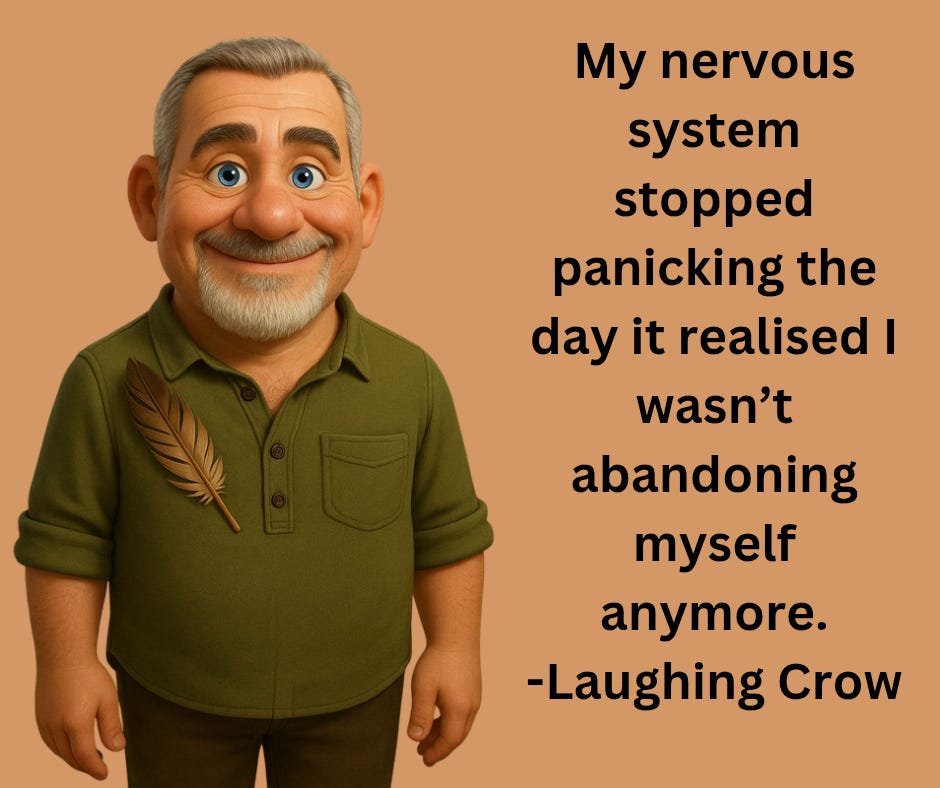
My nervous system had stopped trying to protect me from life.
It had learned I could handle it.
And honestly, that was the most spiritual experience of my life.
Here’s the unsexy truth they don’t put on oracle cards:
You don’t become fearless by thinking better thoughts.
You become fearless by becoming someone your nervous system trusts.
Trust is built through: movement under fear,
repetition under discomfort,
and safety after activation.
You don’t convince your body with philosophy. You demonstrate with behaviour.
Again. And again. And again.
Do I still feel fear?
Of course.
But fear no longer drives the vehicle. It sits in the passenger seat with a seatbelt and no access to the pedals.
It can talk. It just doesn’t vote anymore.
My nervous system isn’t fearless. It’s trained.
Like an old rescue dog that once panicked at every noise and now only barks at the vacuum out of principle.
And that’s enough.
-Laughing Crow
www.living5d3d.com
Overview content…
Curriculum content…
FAQ content…